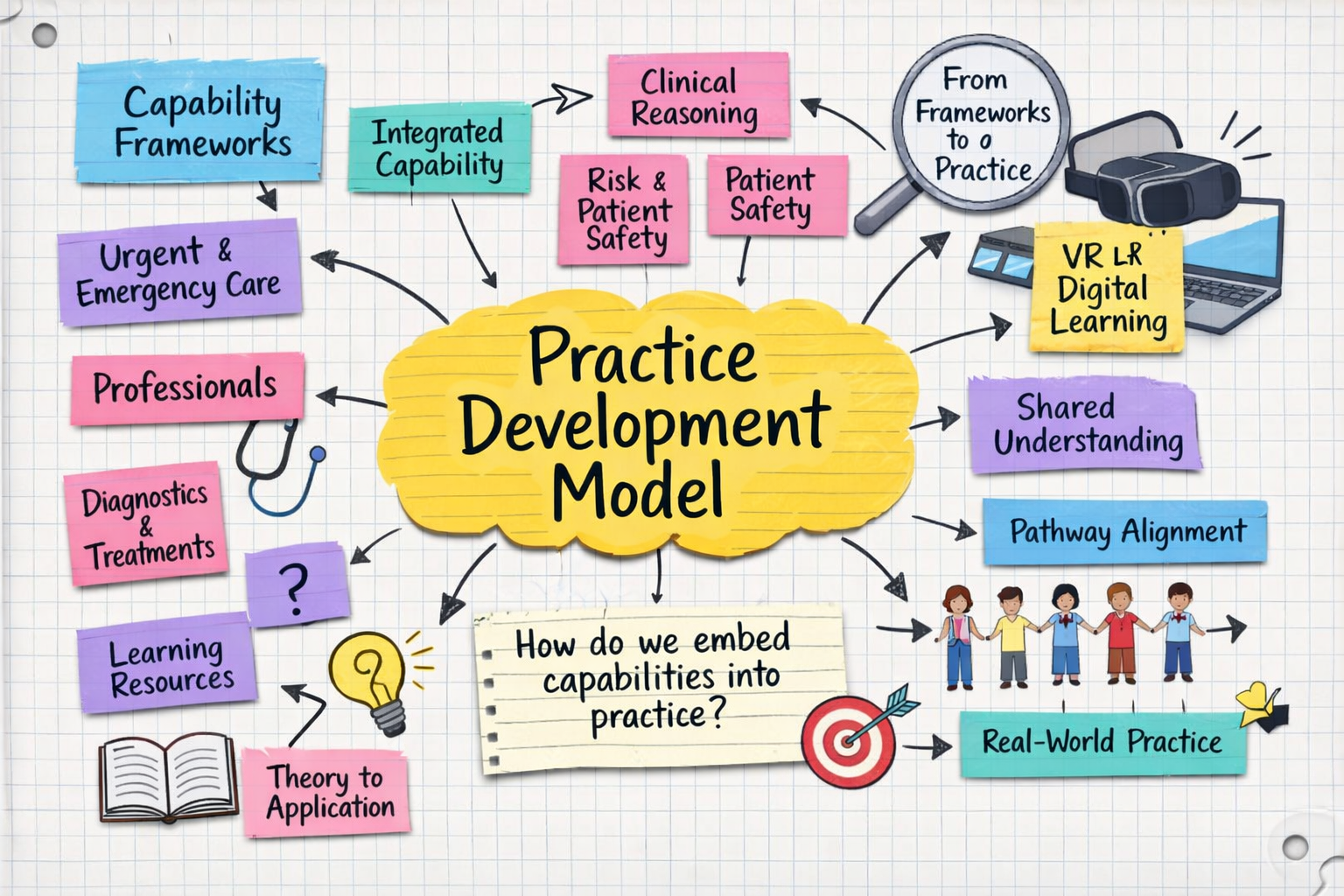
Over the past few months, I’ve been working on integrating capabilities from a range of existing frameworks for AHPs working in urgent and emergency care. The intention was simple—to bring them together into something clearer, more usable, and more relevant to clinicians working across the UEC pathway.
But the deeper I got into the work, the more I started to question whether clarity was really the issue.
Across different frameworks—different professions, settings, and purposes—I kept seeing the same capabilities repeated. Different language. Different structure. But fundamentally, the same expectations.
Which led me to a different question:
If the capabilities are already there… why does it still feel so difficult to consistently apply them in practice?
It’s not a capability problem
The more I reflected, the clearer it became that this isn’t about a lack of capability frameworks. It’s about what happens after they’re written—and how (or whether) they’re actually used.
In urgent and emergency care, the reality often looks very different to how frameworks are structured. Patients don’t move through neat categories in a linear fashion—they move rapidly and unpredictably between different:
professionals
environments
priorities
diagnostics
treatments
While the capabilities themselves remain relevant, they don’t always support consistent application in the way the UEC pathway demands.
So the issue isn’t defining capability—it’s making it usable, transferable, and embedded in real-world practice.
It’s not another framework that’s needed
Somewhere along the way, I realised I wasn’t actually building a framework anymore—or at least, not just a framework.
What I was trying to create was something that:
connects existing capability frameworks
connects clinicians across different parts of the pathway
and connects capability to how people actually learn, develop, and act in practice
What is now starting to take shape is something closer to a practice development model.
Not something that replaces existing frameworks, but something that focuses on:
how capability is nurtured in urgent and emergency care
how it is applied in real clinical situations
and how clinicians build the confidence to use it across the UEC pathway
Because knowing what good looks like isn’t the same as being able to deliver it—especially in complex, high-pressure environments.
And if I’m honest, most clinicians don’t need to be told what to do. They need support to develop themselves, their services, and the pathways they work within.
Testing the idea in practice
One of the most useful things I’ve done so far is map the draft capabilities against my own courses.
Applying the capabilities has shifted the course structure:
from knowledge → to clinical reasoning
from content → to context
from theory → to application
But it’s also raised a bigger question:
How do we support learning that happens outside the clinical environment to translate back into real-world practice?
And how do we do that in a way that is sustainable, builds confidence, improves patient care, and supports integration across the UEC pathway?
Bringing the pieces together
This is where things started to align.
When I first launched TE Tracks, my aim was to create more personalised approaches to learning and development. Alongside that, I’ve been watching the growth of digital learning—platforms, simulation environments, and virtual and augmented reality—with interest, but also some hesitation. I’ve never wanted to lose the value of face-to-face learning, which has been fundamental to both the success of TE Tracks and building clinician confidence.
What this work has helped me realise is that it’s not one or the other.
There’s an opportunity to bring these approaches together—using capability as the anchor—to create something more meaningful.
Because although these technologies already exist in healthcare education, they:
aren’t always designed with AHP practice in mind
often focus on isolated skills rather than decision-making and integration
and are rarely connected into a wider development model
That feels like a missed opportunity—and one that a practice development model can begin to address.
A shared understanding across the pathway
The other gap that keeps coming up is the lack of a shared understanding across the UEC system.
Each part of the pathway often has its own interpretation of:
clinical reasoning
risk
patient safety
integration
Integrating capabilities and developing a practice development model can help create enough alignment that clinicians can:
understand each other
work more seamlessly together
and recognise the value each brings
So where does this leave things?
I’m not trying to create another capability framework.
I’m trying to make better use of what already exists—and build something around it that actually supports people to use it in practice.
What that looks like is still evolving, but starting with an integrated capability framework is an important first step.
Ultimately, the aim is simple:
To support clinicians to feel more confident working across a complex system—and to better demonstrate the contribution that AHPs, alongside others, bring to urgent and emergency care.
What happens next
The next phase is to validate the capabilities to ensure shared agreement and understanding, using a modified Delphi approach.
Once validated, the focus will shift to developing the model into something that can be used, not just read, by:
refining how capabilities translate into practice
developing resources that support learning and application
ensuring it supports integration across the whole UEC pathway
This work will only be meaningful if it’s shaped by the people using it.
If you’re interested in being involved, contributing, or simply following the journey—please get in touch.
