An Occupationally focused approach to preventing hospital admissions – the role of Occupational Therapy in Urgent, Emergency and Crisis Care
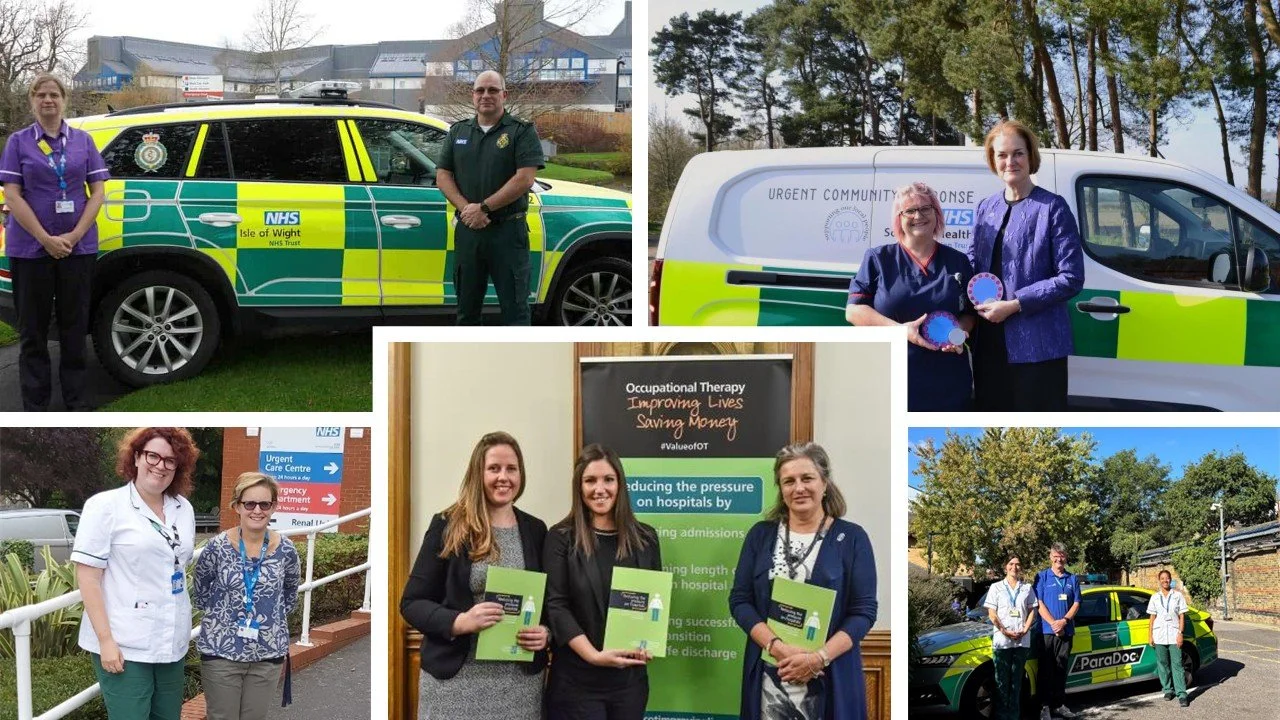
As I shared in my first blog Who I Am and How I ended up here! — Getting Allied Health and Social Care Professionals on the right tracks in Urgent, Emergency and Crisis Care, my introduction to Occupational Therapy came early in my career—and it shaped the way I have viewed urgent and emergency care ever since. I saw its value immediately: when done well, Occupational Therapy does not just treat a problem, it prevents a crisis. It keeps people well, active, safe, and connected. And although I later realised that OT was just one part of a much wider integrated care system, I have never stepped away from the belief that its contribution is not just useful—it is essential.
At its core, Occupational Therapy is grounded in the understanding that meaningful activity and environment shape health. When medicine, nursing, or physiotherapy have taken someone as far as they can, it is often an occupational approach—adapting the task, the environment, or the support around the person—that keeps them independent and avoids an unnecessary admission. It is no coincidence that when the balance between a person’s capability, their occupations, and the environment are out of alignment, crisis follows. And it is precisely this triad that Occupational Therapists are trained to assess, rebalance, and strengthen.
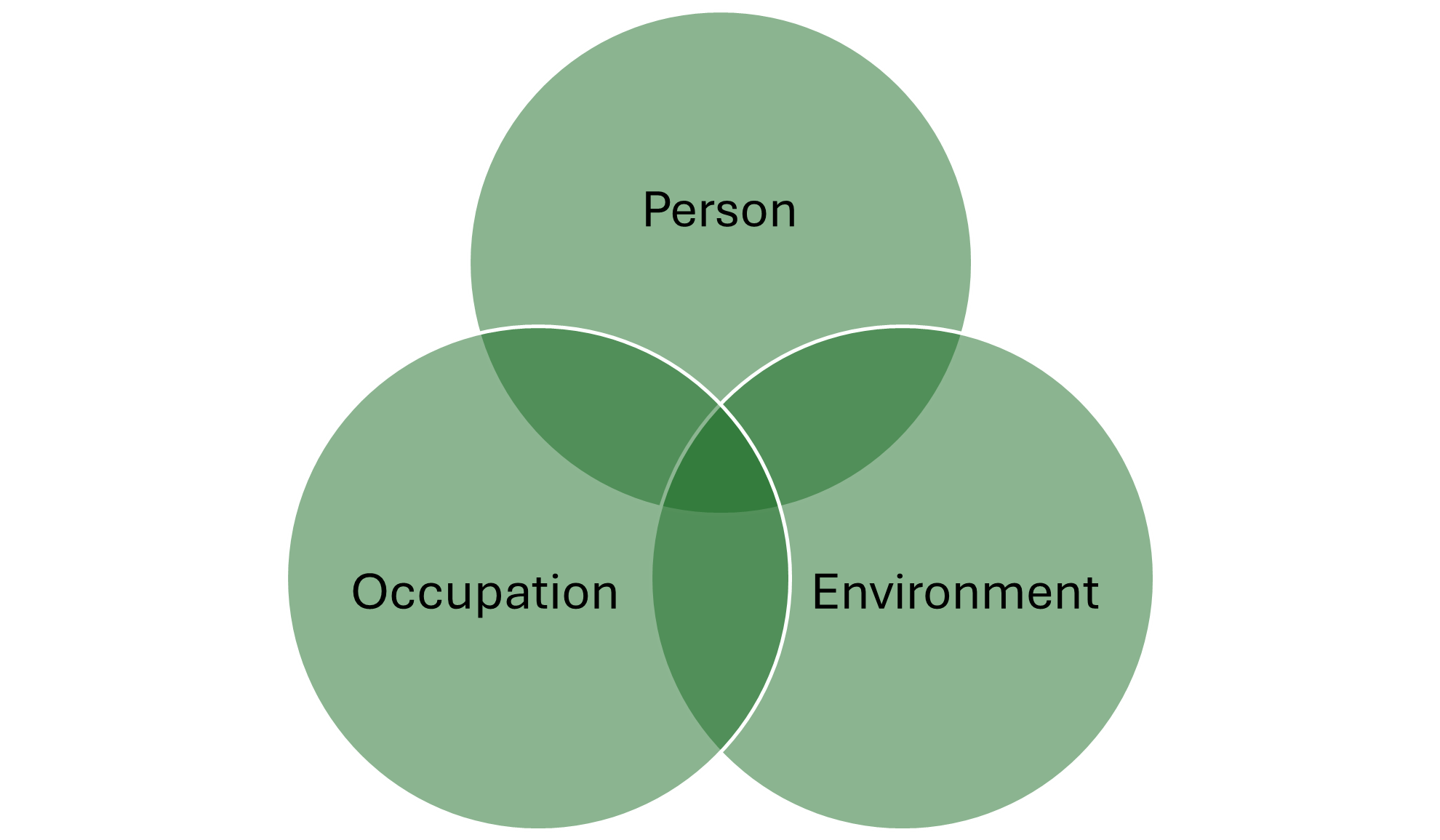
The Person-Environment-Occupation [PEO] venn diagram used by Occupational Therapists to rapidly assess causes for changes in occupational performance.
This is why OT makes such a powerful contribution to urgent and emergency care. Occupational Therapists do not just see risk, symptoms, or tasks—they see the whole system surrounding a person in crisis. They are natural problem-solvers, confident decision-makers, and skilled coordinators. Their distinctive lens cuts through complexity; their approach complements the medical model rather than competing with it. In pressured UEC settings, that blend of holistic reasoning and rapid coordination is worth its weight in gold.
“Occupational Therapists do not just see risk, symptoms, or tasks—they see the whole system surrounding a person in crisis. They are natural problem-solvers, confident decision-makers, and skilled coordinators. ”
When I founded TE Tracks, one of the first things I did was approach every AHP professional body to explore how AHP roles could be strengthened across urgent and emergency care. I received general support from many, but it was the Royal College of Occupational Therapists who stepped forward with a concrete offer: a platform to amplify the voice, expertise, and potential of OTs working in UEC.
I grabbed that opportunity.
I brought together four Occupational Therapists working at different points in the urgent and emergency care pathway so we could shine a light on the breadth of OT practice—and the enormous contribution it already makes:
Sue Norman – an OT working alongside paramedics in a Falls and Frailty Response Service, bringing together rapid assessment with prevention-focused intervention.
Alison Smith – an OT in Urgent Community Response, responding to ambulance referrals within two hours to avoid admission wherever possible.
Lyndsey Sanders – an OT practising in the Emergency Department, using occupational reasoning to prevent avoidable admissions and enable rapid, safe discharge.
Wayne Gillon – an OT leading an integrated service that spans the full pathway, demonstrating what’s possible when services join up instead of working in silos.
And this is what they had to say about OT in urgent and emergency care.
OT in the Falls & Frailty Response Service
Sue brought a frontline view of what it means to integrate Occupational Therapy directly into ambulance-led responses for falls and frailty. Her presentation highlighted how OTs can rapidly differentiate between a medical crisis and a functional or environmental one — often preventing unnecessary conveyance to hospital. She showed how focused occupational assessment at the scene, combined with targeted interventions (equipment, safe transfers, environment adjustments), can stabilise a situation that might otherwise escalate. Sue’s examples demonstrated the genuine system value: reduced ambulance handover pressure, fewer avoidable admissions, and safer outcomes for people who want to remain at home. Her message was simple but powerful: when frailty and function are at the centre of the response, better decisions follow.
Make it stand out
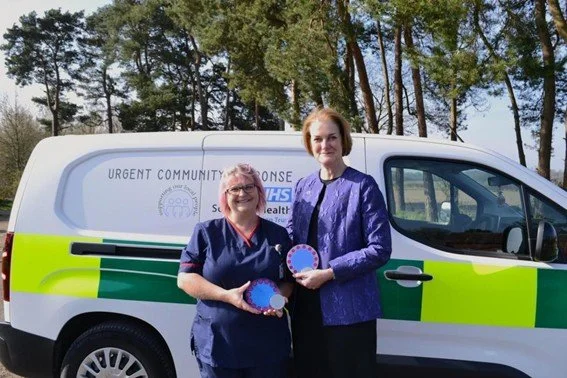
Sue Norman receiving an AHP award from the National AHP Lead Suzanne Rastrick following Sue’s introduction of an electric vehicle for the Falls and Frailty Response Car.
Source: Local Allied Health Professional first to receive new Greener AHP award - Gosport Hospital Radio
OT in Urgent Community Response (2-Hour Crisis Work)
Alison offered a window into the pace and complexity of two-hour UCR work, where Occupational Therapists play a decisive role in avoiding admission. She outlined how OTs assess functional baseline, immediate risks, and environmental barriers in minutes — not hours — and then implement practical solutions that stabilise the person at home. Alison emphasised the occupational approach as the bridge between medical optimisation and real-world capability. She also described the unique value of OT-led coordination: linking equipment providers, community rehab, carers, GPs, and voluntary sector support on the same day. Her case examples showed that the right occupational intervention delivered at the right time can turn an “inevitable admission” into a safe, supported alternative.
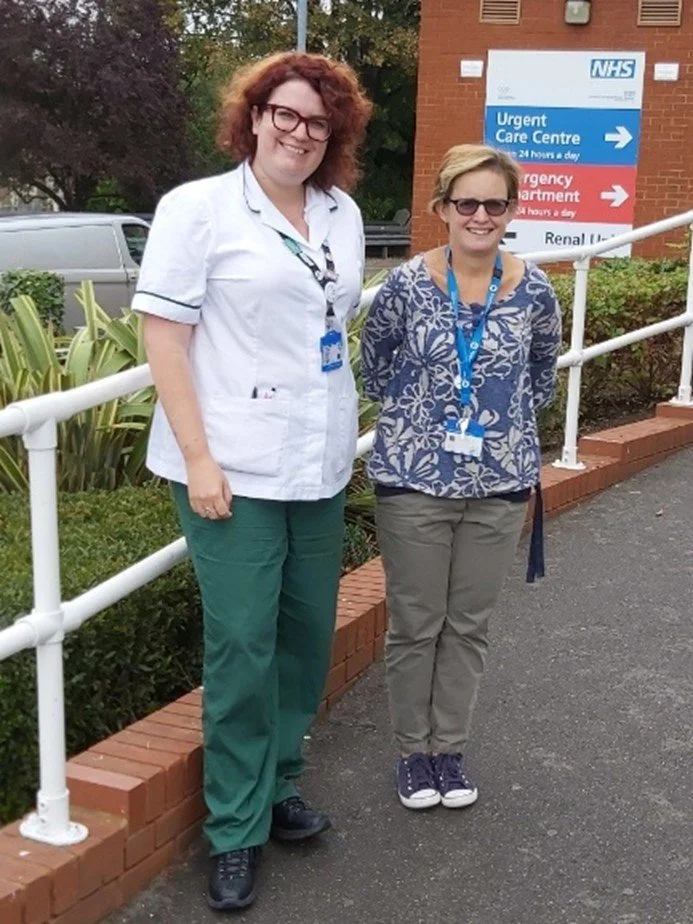
Alison Smith (right) next to ED Occupational Therapist Jessica Dawson (left) during a project to work more collaboratively between the Urgent Community Response service and local ED Therapy Team.
Source: Thomas Edwards (author)
OT in the Emergency Department
Lyndsey explored the critical role Occupational Therapists play in ED decision-making, especially when medical stability does not automatically mean someone can return home safely. Her presentation centred on the “occupational gap” that often goes unnoticed in emergency settings — the mismatch between someone’s usual function and what they can do at that moment. She showed how OTs identify this gap quickly and use targeted, practical interventions to prevent unnecessary admissions that add no value. Lyndsey also highlighted the leadership OTs bring in shaping discharge pathways, reducing delays, and improving patient flow. Her message was clear: when Occupational Therapists are embedded into ED culture, the whole stem works more efficiently.
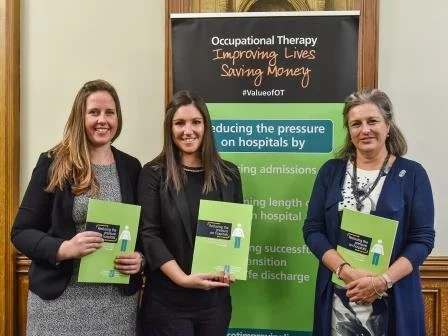
Lyndsey’s colleagues Georgia Harding and Tahlia Levin from the Barnet Hospital have previously supported the Royal College of Occupational Therapists to publish a report on the role of Occupational Therapy within the Emergency Department.
OT in an Integrated Service Across the UEC Pathway
Wayne provided the strategic lens, showing what becomes possible when Occupational Therapy is embedded end-to-end across urgent and emergency care. He described an integrated service model that spans ambulance response, community crisis teams, emergency departments, short-stay units, and supported discharge. Wayne emphasised how consistency in occupational therapy assessment across the pathway reduces duplication, shortens length of stay, improves continuity, and strengthens patient safety. He also highlighted the enabling leadership role OTs can take — shaping pathways, influencing culture, and supporting multi-professional decision-making. His presentation showcased what a mature, integrated UEC system could look like when Occupational Therapy is positioned not as an add-on, but as part of the core clinical infrastructure.
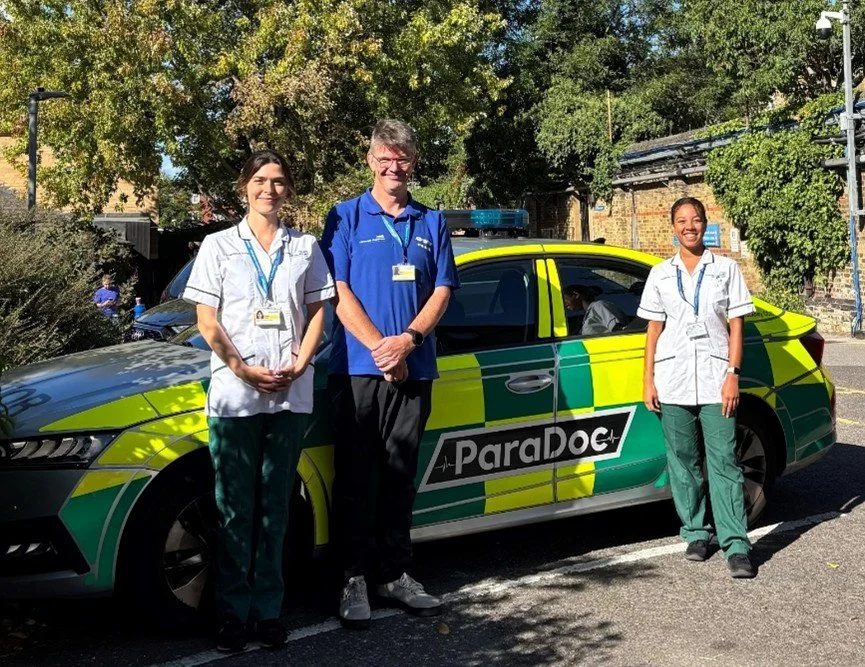
Occupational Therapists working alongside a paramedic as part of the Paradoc service. This is an integrated service between Homerton Hospital and City & Hackney urgent and emergency care services.
Source: City & Hackney Urgent and Emergency AHP presentation by Wayne Gillon – see RCOT link below.
OT in Mental Health Crisis Response
Alongside the RCOT Innovation event, there has also been a new community of practice created for Occupational Therapists working in mental health crisis response and home treatment teams. This has been set up and led by Kosiwa Nicholls, AHP Lead for Hampshire and Isle of Wight NHS Trust. Despite different challenges and pressures, the CRHTT OT group shared the same passion and insight into the unique value of Occupational Therapists in crisis care, with a strong focus on occupation and the environment as both assessment to identify triggers and treat cause of mental distress, and the unique problem solving and all encompassing approach that Occupational Therapists bring to the care of patients. Occupational Therapists in both physical and mental health urgent and emergency care settings also strongly recognise the value of not over medicalising the person’s presentation and recognising that treatment does not always need to start with medications. This approach therefore not only offers quality care to patients but cost effectiveness to the system.
Mental Health Response Teams are on the rise across the country. Whilst mostly staffed by Mental Health Nurses or Mental Health Practitioners, I am sure that we will soon see Occupational Therapists working on these resources in the same way they already do for physical health responding.
OT as part of the future for Urgent and Emergency Care
Each presentation illustrates the same point in a different way: Occupational Therapy already plays a pivotal role in urgent and emergency care—but its potential is far greater than the system currently allows. As we build integrated pathways across an ambulance-led UEC system, we will need to ensure all AHPs are included, but I honestly believe that OT must be front and centre to ensure pathways offer value and have impact.
“ I honestly believe that OT must be front and centre to ensure pathways offer value and have impact.”
Occupational Therapy brings a capability set that aligns perfectly with future UEC priorities: prevention, integration, personalisation, flow, frailty, rehabilitation, community-first care, and crisis response rooted in what matters to the person. The more complex our system becomes, the more vital that skillset is.
And as I look at the future vision—integrated health, social care, education is and emergency response systems that prevent crisis rather than simply react to it—I keep coming back to the same conclusion: Occupational Therapy is not a niche contributor to UEC; it’s one of its most future-proof assets.
The recordings and presentations can all be found on the RCOT Innovations forum at: RCOT Innovations Forum
