Clinical Simulation: An Untapped Opportunity for AHPs in UEC
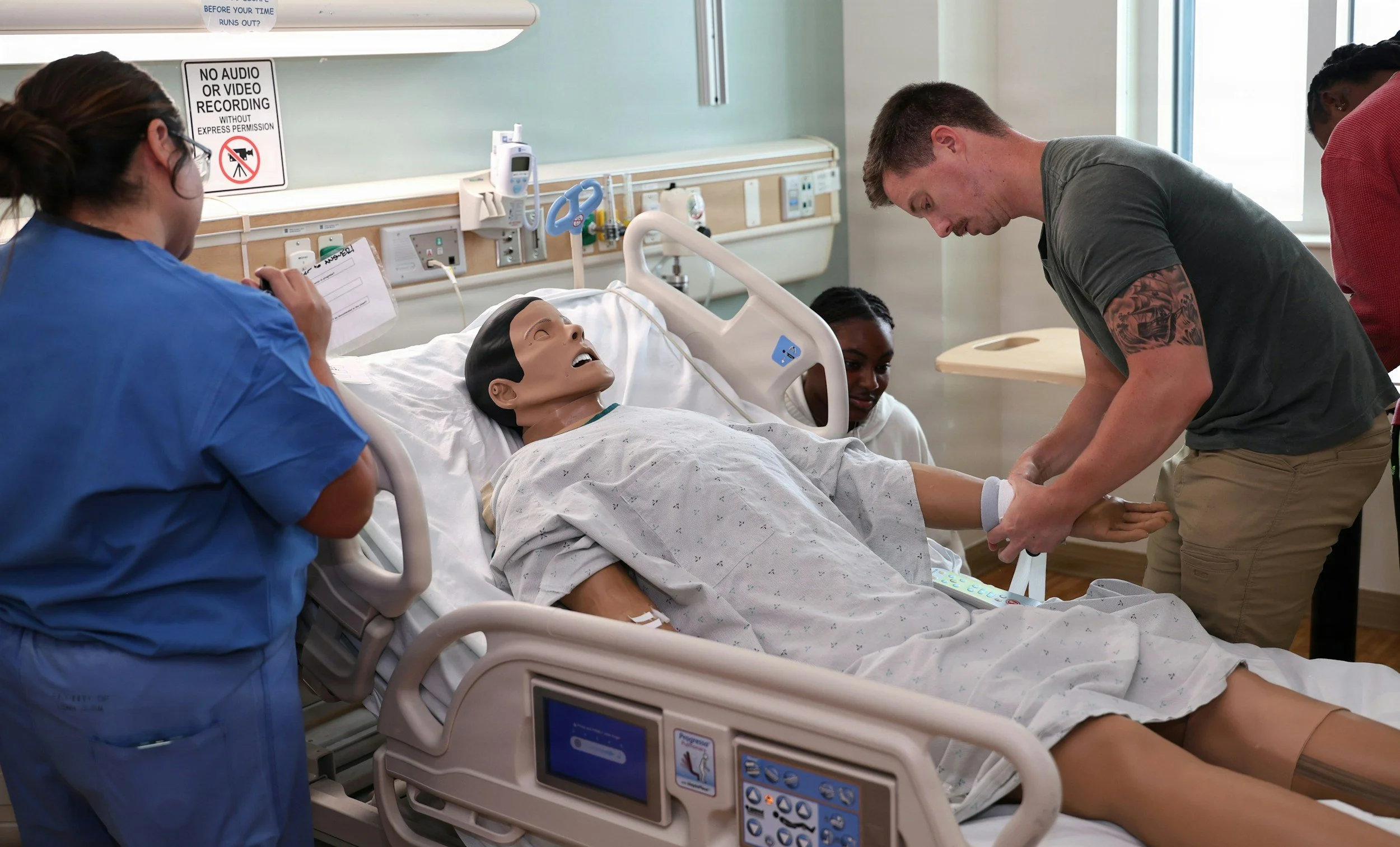
When many clinicians hear the term clinical simulation, they immediately think of cardiac arrests, trauma calls, resuscitation teams and high-fidelity mannequins.
Whilst simulation certainly has an important role in preparing clinicians for rare and high-risk events, limiting its use to emergency procedures risks overlooking one of the most powerful educational tools available to us.
Simulation-based education is an educational approach that recreates real or realistic clinical situations, allowing individuals and teams to learn, practise and reflect in a safe environment.
For Allied Health Professionals (AHPs) working across urgent, emergency and crisis care (UEC), simulation offers something much broader than practising clinical procedures. It provides opportunities to develop clinical reasoning, strengthen multidisciplinary working, improve communication, explore complex decision-making and ultimately enhance patient care.
This blog is not intended to be a definitive guide to simulation. Instead, it offers a practical framework to help you design simple simulation activities that support learning within your own service.
Why Simulation Matters
Although simulation is well established within many medical and nursing education programmes, it remains underused across many AHP services.
As AHP roles continue to expand across UEC, simulation provides an opportunity not only to develop knowledge and skills, but also to build confidence, judgement and collaboration. It also allows AHPs to demonstrate their unique contribution whilst helping other professions better understand each other's roles.
Designing an effective simulation involves much more than writing a realistic scenario. It requires careful consideration of:
the challenge you want to address
the learning objectives
the most appropriate simulation method
who should be involved
the learning environment
how learning will be evaluated.
Reflection
Where could simulation help your team feel more confident before facing these situations in practice?
Start Small and Build
Many clinicians assume simulation requires expensive equipment, dedicated simulation suites or significant organisational support.
In reality, some of the most effective simulations are simple, short and based on everyday clinical practice.
A ten-minute scenario followed by a structured debrief may have greater educational value than an elaborate simulation attempting to achieve too many learning outcomes.
The aim is not to create the perfect simulation.
The aim is to create a safe space for learning.
Reflection
What's the simplest simulation you could deliver within your own clinical area?
Define the Challenge
The most effective simulations begin with a real clinical challenge rather than a simulation scenario.
Instead of asking:
"What simulation should we run?"
consider asking:
"What situations do our team find most challenging?"
Examples might include:
managing deterioration
complex discharge planning
balancing positive risk-taking
safeguarding concerns
difficult conversations
disagreements within the MDT
prioritising patients when demand exceeds capacity.
Simulation allows teams to rehearse not only what they do, but how they think, communicate and work together.
Reflection
What common patient presentation or clinical situation would benefit most from simulation?
Decide What You Want People to Learn
Once you've identified the challenge, the next step is to define the learning objectives.
Before writing the scenario, ask yourself:
What do I want participants to understand?
What should they do differently afterwards?
Is the focus on clinical knowledge, communication, leadership, teamwork or decision-making?
Aim for one to three learning objectives.
Keeping the objectives focused helps participants understand the purpose of the simulation and provides a clear structure for the debrief.
Remember, not every simulation needs to assess clinical knowledge. Some of the richest learning comes from exploring uncertainty, communication and teamwork.
Reflection
If participants remembered only one or two things from your simulation, what would you want them to be?
Choose the Right Simulation Method
Different learning objectives require different simulation methods.
Examples of simulation types include:
Task trainers – practising individual clinical skills such as venepuncture or splinting.
High-fidelity simulation – advanced mannequins recreating realistic clinical scenarios.
Simulated patients – trained actors supporting communication, assessment and shared decision-making.
Tabletop exercises – facilitated discussions exploring pathways, prioritisation and decision-making.
In situ simulation – scenarios delivered within the clinical environment using real teams, equipment and processes.
The best simulation is not necessarily the most technologically advanced.
Choose the method that best supports the learning objectives.
Reflection
Which simulation method would best help participants achieve your learning objectives?
Learn Together
Simulation offers valuable opportunities for multidisciplinary learning.
Healthcare increasingly depends on collaboration, yet much of our education still occurs within professional silos.
Simulation enables clinicians to learn with, from and about one another.
For example, bringing together Occupational Therapists, Physiotherapists, Nurses, Doctors, Social Workers and other professionals can help teams understand different perspectives, clarify professional roles and strengthen collaborative decision-making.
Running the simulation is only part of the learning experience. Much of the learning takes place during the debrief, where participants reflect together in a psychologically safe environment.
Reflection
Which professions could be involved to best reflect real clinical practice?
Think Beyond Clinical Skills
Clinical knowledge is only one component of effective patient care.
Consider the analogy of the iceberg. Above the surface of the iceberg are the technical skills we often focus on. Beneath the surface lie the less visible influences on performance, including:
communication
teamwork
leadership
situational awareness
decision-making
understanding professional roles.
These hidden influences are collectively known as human factors and often have a greater impact on patient care than technical skills alone.
Simulation provides a unique opportunity to explore these human factors safely before clinicians encounter similar situations in practice.
Reflection
Beyond the clinical problem, what communication, leadership or decision-making challenges could you build into your simulation?
Evaluate and Build the Case
Simulation should not be viewed simply as training.
It is an investment in workforce capability, patient safety and service improvement.
Whilst simulation does not have to be expensive, it should be evaluated.
Rather than simply asking participants whether they enjoyed the session, consider whether the simulation influenced:
confidence
teamwork
communication
clinical decision-making
patient safety
service processes
quality improvement.
Collecting meaningful feedback helps demonstrate impact, supports future investment and creates opportunities to share learning more widely.
Reflection
What difference do you hope your simulation will make—and how will you know if it has?
Final Thoughts
Clinical simulation is not simply about preparing clinicians for the next emergency. It is about helping people think, communicate, collaborate and lead more effectively when caring for people with complex needs.
You don't need expensive equipment, a dedicated simulation suite or a perfect scenario to get started. Begin with the challenges your team faces every day. Keep the learning objectives simple. Create a psychologically safe environment. Learn together. Reflect together. Build from there.
If you are interested to explore using simulation-based education for AHPs working in UEC, you can explore the resources below or look into the clinical simulation offer provided by your organisation.
Useful Resources
Association for Simulated Practice in Healthcare (ASPiH) – Standards, faculty development and educational resources.
Clinical Human Factors Group (CHFG) – Practical guidance on applying human factors in healthcare.
Chartered Institute of Ergonomics and Human Factors (CIEHF) – Human factors principles and learning resources.
Faculty of Medical Leadership and Management (FMLM) – Leadership development relevant to simulation and team working.
NHS Leadership Academy – Resources on compassionate, collaborative and systems leadership.
Your local Clinical Simulation Faculty or education team – Many NHS organisations already have simulation educators who can support clinicians wishing to get started.
