
Over the last few years, I have noticed an increasingly common debate across urgent, emergency and crisis care.
Should we be protecting professional roles or creating trans-disciplinary roles?
The growth of Enhanced Practice and Advanced Practice has only intensified this discussion. Whether it is professionals developing skills traditionally associated with another profession, or multi-professional practitioner roles such as First Contact Practitioners and Advanced Clinical Practitioners, questions about professional boundaries seem to surface wherever workforce transformation is discussed.
The debate is often presented as a choice between the two.
I think that is the wrong question.
The real challenge is not choosing between professional identity and trans-disciplinary practice. It is creating trans-disciplinary roles whilst protecting professional identity.
What Do We Mean by Trans-disciplinary?
For me, trans-disciplinary practice exists on a spectrum.
At one end are professionals who develop broader capabilities beyond traditional professional boundaries whilst maintaining a clear professional identity.
At the other are practitioner roles intentionally open to multiple professions and designed around the needs of a service rather than a specific profession.
Both approaches are increasingly important in urgent and emergency care.
Patients rarely present with needs that fit neatly within a single professional discipline. They present with combinations of acute illness, frailty, functional decline, social complexity, mental health needs and environmental challenges. At the same time, services cannot always sustain every professional group in every setting, every day of the week.
The reality is that some of the most effective services I have worked in could not function without clinicians working beyond traditional professional boundaries.
Importantly, it works.
When Integration Feels Like Erosion
As an Occupational Therapist, I have experienced both the benefits and frustrations of role integration.
I have worked in services where skills were shared, learning was encouraged and professional expertise was respected. I have also worked in environments where elements of Occupational Therapy gradually became absorbed into other roles, creating an implied question:
"If someone else can do this, do we still need Occupational Therapists?"
Many professions have experienced similar concerns.
This is where much of the tension originates.
What is often described as integration can sometimes feel like professional erosion.
The problem is not trans-disciplinary practice itself. The problem is when role development is pursued without recognising the expertise, values and perspectives that professions bring.
The Difference Between Generic and Trans-disciplinary
For years, many clinicians working at the front door of healthcare have been described as operating in "generic" roles.
I have never found that term particularly helpful.
Generic suggests replacing difference.
Trans-disciplinary suggests bringing difference together.
The distinction matters.
In a generic model, professional identity becomes diluted and tasks become interchangeable.
In a trans-disciplinary model, professional expertise remains visible and valued, whilst individuals develop additional knowledge and skills that allow them to contribute more broadly.
Patients benefit from flexibility.
Services benefit from efficiency.
Staff benefit from development.
But only when professional expertise remains respected.
When one profession dominates, integration quickly becomes role substitution rather than collaboration. That creates defensiveness, territorial behaviour and ultimately limits the potential benefits for patients and staff alike.
The Mistake We Keep Making
Where organisations often struggle is assuming trans-disciplinary roles are primarily a workforce solution.
A practitioner role is introduced.
A competency framework is developed.
Responsibilities are redistributed.
Then everyone hopes integration will happen naturally.
In reality, it rarely does.
Successful trans-disciplinary roles require organisations to understand exactly what problem they are trying to solve.
How does the role improve patient outcomes?
How does it support workforce sustainability?
How does it reduce pressure elsewhere in the system?
How does it complement existing professional roles?
How will it adapt as system needs change?
Without answering these questions, trans-disciplinary roles risk becoming temporary solutions to permanent problems.
Why Professional Identity Still Matters
Professional identity is not something that should be overcome.
It is something that should be valued.
Professions did not emerge by accident. They developed because society recognised a distinct contribution that improved outcomes for patients and communities.
The challenge is that years of financial pressure, workforce shortages and organisational change have created both a greater need for flexibility and a greater tendency towards professional protectiveness.
Too often, professions become focused on protecting their own contribution rather than understanding the contribution of others.
Yet genuine collaboration depends on both.
Strong professional identities should not create barriers between professions. They should create confidence in what each profession contributes.
Efficiency and Effectiveness
While reflecting on this topic, I realised something.
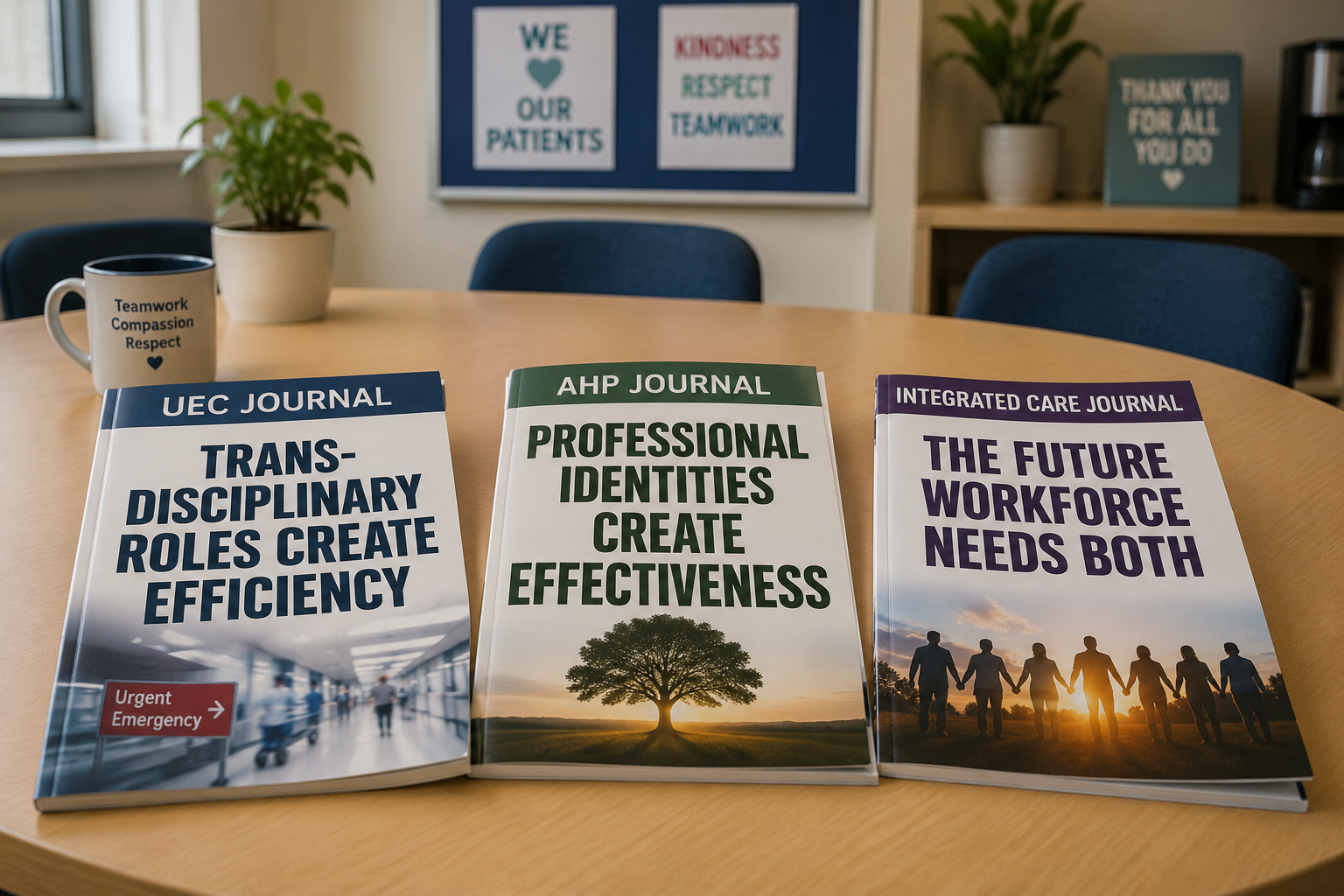
Trans-disciplinary roles often create efficiency.
Professional identities create effectiveness.
Healthcare systems need both.
Efficiency helps us manage demand.
Effectiveness helps us improve outcomes.
Neither is sufficient on its own.
The greatest opportunity lies in creating trans-disciplinary roles that improve efficiency whilst retaining the professional expertise that drives effectiveness.
That is where the real value sits.
A Different Way Forward
Perhaps the first step is changing our language.
Rather than talking about generic roles, we should talk about trans-disciplinary roles.
Words matter.
Generic implies replacing professions.
Trans-disciplinary implies connecting them.
We should also be willing to open trans-disciplinary roles to all professions where appropriate, with entry criteria based on the needs of the role rather than assumptions about professional background.
At the same time, organisations must actively invest in professional development, supervision and professional identity.
Integration should never mean abandoning professional expertise.
It should mean applying it differently.
There is also an important leadership opportunity here.
Trans-disciplinary practitioners are often uniquely placed to connect professional perspectives, challenge assumptions and build mutual understanding across teams. Perhaps their most important capability is not performing another profession's role, but recognising the limits of their own expertise and knowing when another professional perspective is needed.
Trust grows when professions understand each other's value.
Confidence grows when expertise is recognised.
Patients benefit when teams utilise the full breadth of knowledge available to them.
No Role Replaces a Team
Ultimately, I do not believe trans-disciplinary roles threaten professional identity.
Poorly designed generic roles do.
When built thoughtfully, trans-disciplinary roles can strengthen services, improve patient care and create more sustainable systems.
But no role, regardless of how broad its scope becomes, can replace a multidisciplinary team.
A role can support a team.
A role can connect a team.
A role can enhance what a team delivers.
But it cannot become the team.
The future of urgent, emergency and crisis care will not be built on increasingly rigid professional boundaries.
Nor will it be built on professions disappearing into generic workforce models.
It will be built on mutual respect, shared learning and a recognition that different expertise brings different value.
The goal is not to become the same.
The goal is to work together better.
And when we achieve that balance, both professional identity and trans-disciplinary practice become stronger.
