One of the things that has increasingly interested me during my time working in urgent and emergency care is what I have come to think of as the revolving-door effect.
Someone presents to UEC.
The immediate problem is assessed and managed.
They leave.
Then they come back.
Perhaps the presentation is slightly different. Perhaps it is the same problem. Perhaps there is another fall, another episode of dizziness, another functional neurological episode, another crisis. Eventually, the pattern becomes obvious.
By this point, the person may be described as a frequent attender or a high-intensity user. The interesting part is that there are established approaches for trying to coordinate their care.
But I have been wondering about the point before that. What happens when the pattern is only just beginning to emerge? And, more importantly, when should we intervene?
The problem with the labels
There is considerable literature around people who frequently use emergency departments.
Definitions vary, but five or more ED attendances within 12 months is commonly used to define frequent attendance or high-intensity use. A recent analysis of national English data similarly used five or more attendances per year as the standard threshold for frequent attendance, with ten or more used clinically in some settings to describe higher-intensity use. Health Equity Evidence Centre
These definitions are useful as they allow services to identify a population. They allow data to be analysed, and they provide a trigger for developing specific approaches such as care planning, case management and multidisciplinary working. And there is good reason to do so.
· A systematic review found that people who frequently attend emergency departments are a heterogeneous group with complex healthcare needs, and that early identification creates opportunities for alternative models of care. PubMed
· More recently, the Health Equity Evidence Centre reviewed 46 studies and identified several recurring components of approaches that may better support people who frequently attend EDs: identification using screening tools alongside clinical judgement, good primary care access and continuity, integrated multidisciplinary services and a whole-person approach. Health Equity Evidence Centre
· The Royal College of Emergency Medicine's guidance similarly emphasises coordinated care, care planning where appropriate, involvement of the wider multidisciplinary team and involving the person themselves in developing a care plan. RCEM
So, the problem isn't that we don't know how to support frequent attendance. So, the question I keep coming back to is what happens before someone reaches that definition.
The missing middle
Imagine someone who has attended UEC twice in the last few months with similar problems such as a fall. Nothing about either presentation necessarily screams “high-intensity user”, and so there is no reason to activate a formal frequent-attender process. But then they come back a third time.
And this is where I think there is an opportunity to step back for a moment. Because three presentations in a short time could indicate an emerging pattern. Three presentations that individually make sense but collectively might suggest that something has not yet been addressed or potentially missed.
I am not suggesting that three presentations should become a new national definition of frequent attendance. Nor am I suggesting that every person who presents three times needs a new pathway, case manager or specialist referral. But three or more similar or related presentations can be a useful prompt to stop and ask whether the pattern itself is telling us something.
The opportunity is to intervene while the pattern is still emerging rather than waiting until the person has accumulated enough attendances to meet a high-intensity threshold. That is where I think urgent and emergency care has an opportunity to do something different.
Why falls?
Falls are a useful example because many people are brought to the Emergency Department to rule out an injury or illness. But once this is excluded, there is much less consideration for the cause of the fall. This can be appropriate on the first and maybe even the second fall, but three or more falls can lead to a label of “frequent faller” without any actual intervention. And more concerning, there can be a risk that we accept falls as inevitable consequence of ageing despite the breadth of opportunities to reduce falls risk.
Perhaps unsurprisingly as an Occupational Therapist, I have found that more often than not falls are often multi-factorial, with risk arising from the interaction between the person, their environment, and the activities they undertake. The PEO model used by Occupational Therapists offers a Venn diagram that can explain and help us to understand this relationship.
The PEO model offers a useful way of exploring underlying causes for presentations such as falls. The model can help consider the factors and relationships between the person, their environment and the occupations or activities they engage in. Therefore, even when we cannot change the person's underlying impairment, we may still be able to change the circumstances in which they undertake an activity.
For me, this creates an important shift in thinking. If we cannot immediately change something about the person, perhaps we can change the environment. And if we cannot change the environment, perhaps we can change how the activity is performed.
Or perhaps we can change the relationship between all three. The objective isn't necessarily to make the person “better”. It may be to make the person–environment–occupation relationship work better. And sometimes that may be enough to change what happens next.
And of course, this can be applied to many other UEC presentations where there is no apparent acute underlying illness or concern.
But when do we intervene?
Let’s take the example of the person who has now presented three times following a fall:
· The immediate assessment still matters.
· We still need to understand what happened.
· We still need to consider injury.
· We still need to consider cardiovascular and neurological contributors where appropriate.
· We still need to understand the person's circumstances and associated symptoms.
But the third presentation also gives us something that the first presentation didn't necessarily give us:
information about the pattern.
That is the point at which I started asking myself whether there was a simple way of translating some of the existing guidance around recurrent presentations into a practical clinical reasoning process.
Not another pathway, referral form or definition of a frequent attender. But something much simpler.
Introducing the UEC model
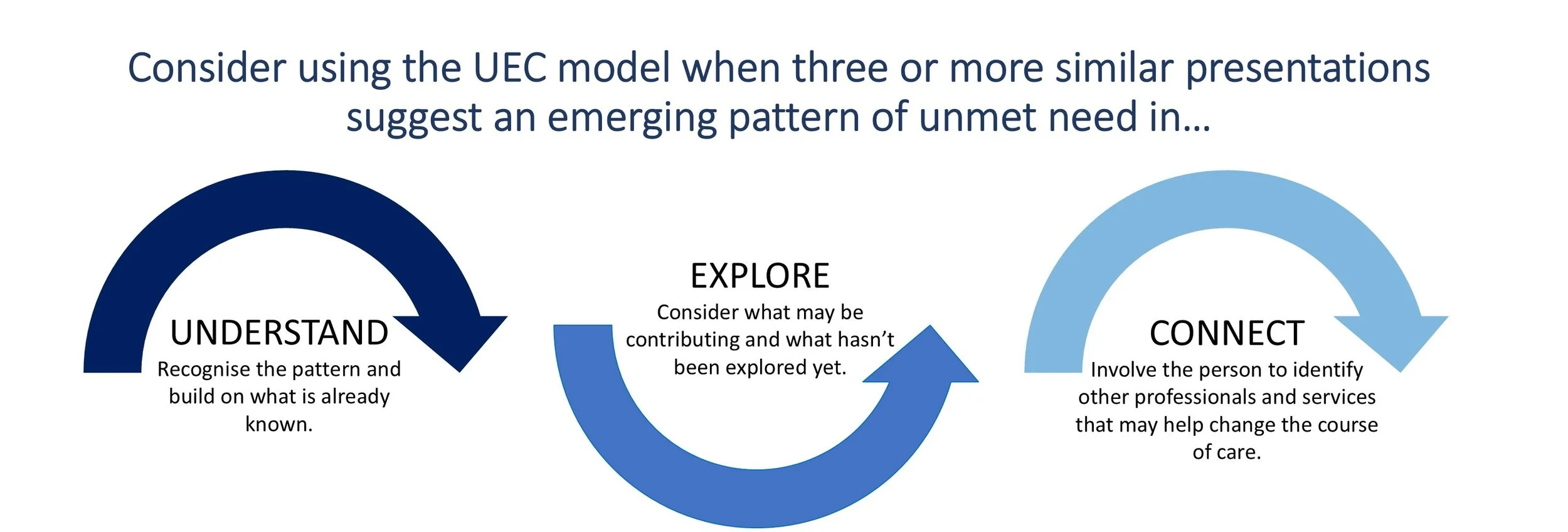
The result is what I have called the UEC model – Understand, Explore, Connect
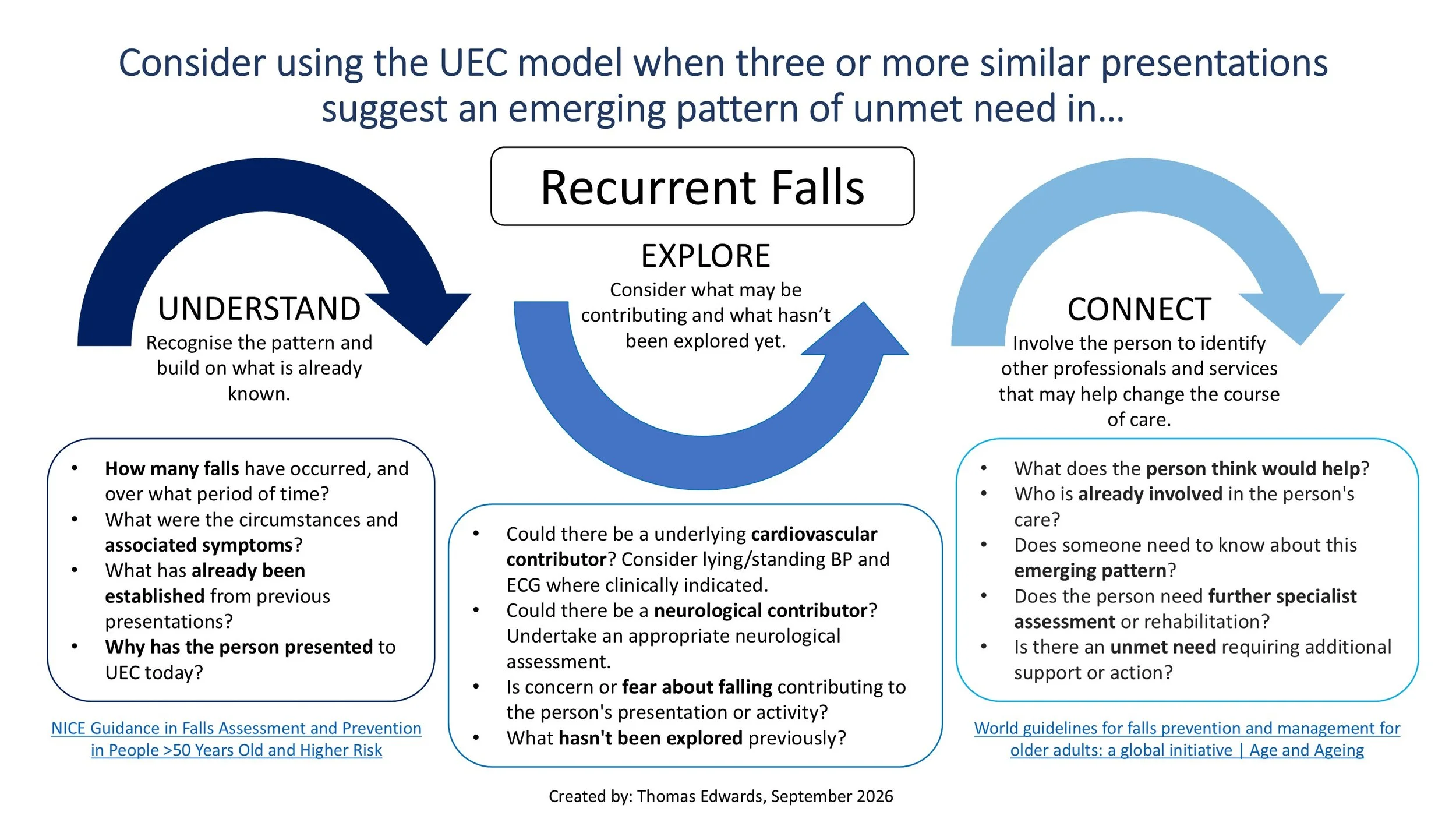
UNDERSTAND
Recognise the pattern and build on what is already known:
· How many times has this happened?
· Over what period?
· What were the circumstances?
· What symptoms were associated with the previous presentations?
· What has already been established?
And perhaps most importantly: Why has the person presented to UEC today?
The purpose isn't to repeat everything that has already been done.
It is to join the dots.
EXPLORE
Consider what may be contributing and what hasn't been explored yet.
Once we recognise the pattern, the question becomes: What might we have missed?
With recurrent falls, that might mean considering cardiovascular or neurological contributors, reviewing medication or other recognised risk factors, exploring fear or concern about falling, or looking at whether previous assessments have actually addressed the circumstances in which the falls are occurring.
NICE's current falls guidance recommends comprehensive assessment covering areas including cardiovascular factors, cognition and mood, dizziness, functional ability, concerns about falling, gait, balance, mobility and strength, alongside other relevant factors. NCBI
The World Falls Guidelines similarly place emphasis on asking about previous falls, unsteadiness and concerns about falling, with further assessment based on the responses. PubMed Central (PMC)
The point isn't to turn every UEC clinician into a falls specialist. It is to recognise that repeated presentation creates an opportunity to ask a slightly different question: What haven't we explored yet?
CONNECT
Involve the person to identify other professionals and services that may help change the course of care.
This is perhaps the most important part. Because recognising a problem doesn't change it, something has to happen next. But that doesn't necessarily mean a new referral or a longer admission. The person may already have professionals involved in their care.
There may already be an existing falls, frailty, rehabilitation, primary care, neurological or community service involved in the person’s care. There may be another team available locally that the UEC clinician simply needs to connect with. Or there may actually be an unmet need that requires a different response.
And I think there is one question that is particularly easy to overlook: What does the person think would help?
That question changes the nature of the conversation. We are no longer simply asking: “Where can I refer this person?”. Instead, we are asking: “What might actually change the course of care for this person, and who might be able to help?”
The model isn't a pathway.
The UEC model isn't intended to replace local pathways. It doesn't assume that every organisation has the same services or say that every person with three falls needs a falls service. It doesn't say that every person with recurrent presentations needs case management, and it certainly isn't intended to replace comprehensive assessment or clinical judgement.
Instead, it provides a reasoning prompt that can help clinicians:
· Recognise the pattern.
· Build on what is already known.
· Explore what might be contributing.
· Identify what hasn't been explored.
· Then connect the person with the people, services or interventions that might make a difference.
For me, this also highlights why multidisciplinary team (MDT) working is so important in UEC, and how AHPs can contribute to a more comprehensive understanding of a person's needs. Take someone who presents repeatedly following falls. AHPs can help us look beyond the immediate presentation to understand how a health problem affects the person's function, independence and daily life. Different AHP professions bring different expertise, and their involvement should depend on the person's needs rather than whether that professional is available.
I'm not suggesting that every AHP needs to work in UEC. However, I do think we need to ensure that AHPs have the capability and clinical leadership, and access to their services is needed to contribute their expertise when it could make a difference. Recognising an opportunity to intervene is only useful if we can connect the person with the right support.
And that is precisely why I don't see this as simply a “falls pathway”. It is an example of how different professional perspectives can change the question being asked — and potentially the course of care that follows.
From managing presentations to changing trajectories
Perhaps the most important idea behind the UEC model is therefore quite simple. We are very good at responding to presentations and we are increasingly developing systems for responding to high-intensity use. But there may be an opportunity in between. The point where the pattern is beginning to emerge.
So, if a person whose individual presentations make sense but whose collective story raises a different question, then this is where I think we should be asking:
Can we change the course of care before the revolving door becomes established?
Perhaps the opportunity for UEC is not always to create another pathway. Perhaps sometimes it is simply to recognise that the third presentation isn't just another presentation, but that it might be the first opportunity to see the pattern.
References:
Health Equity Evidence Centre — What works: Finding ways to better support people who frequently attend emergency departments Health Equity Evidence Centre
Royal College of Emergency Medicine — Best Practice Guideline: Frequent Attendance RCEM
NICE NG249 — Falls: assessment and prevention in older people and in people 50 and over at higher risk NCBI
World Falls Guidelines — guidance on falls prevention and management
Tinetti & Kumar — The Patient Who Falls: “It's Always a Trade-off” PubMed Central (PMC)
OTIS / NIHR — Home environmental assessments and modification delivered by occupational therapists to reduce falls.
