What Does Enhanced Clinical Practice Capability Actually Look Like for AHPs Working in Urgent and Emergency Care?
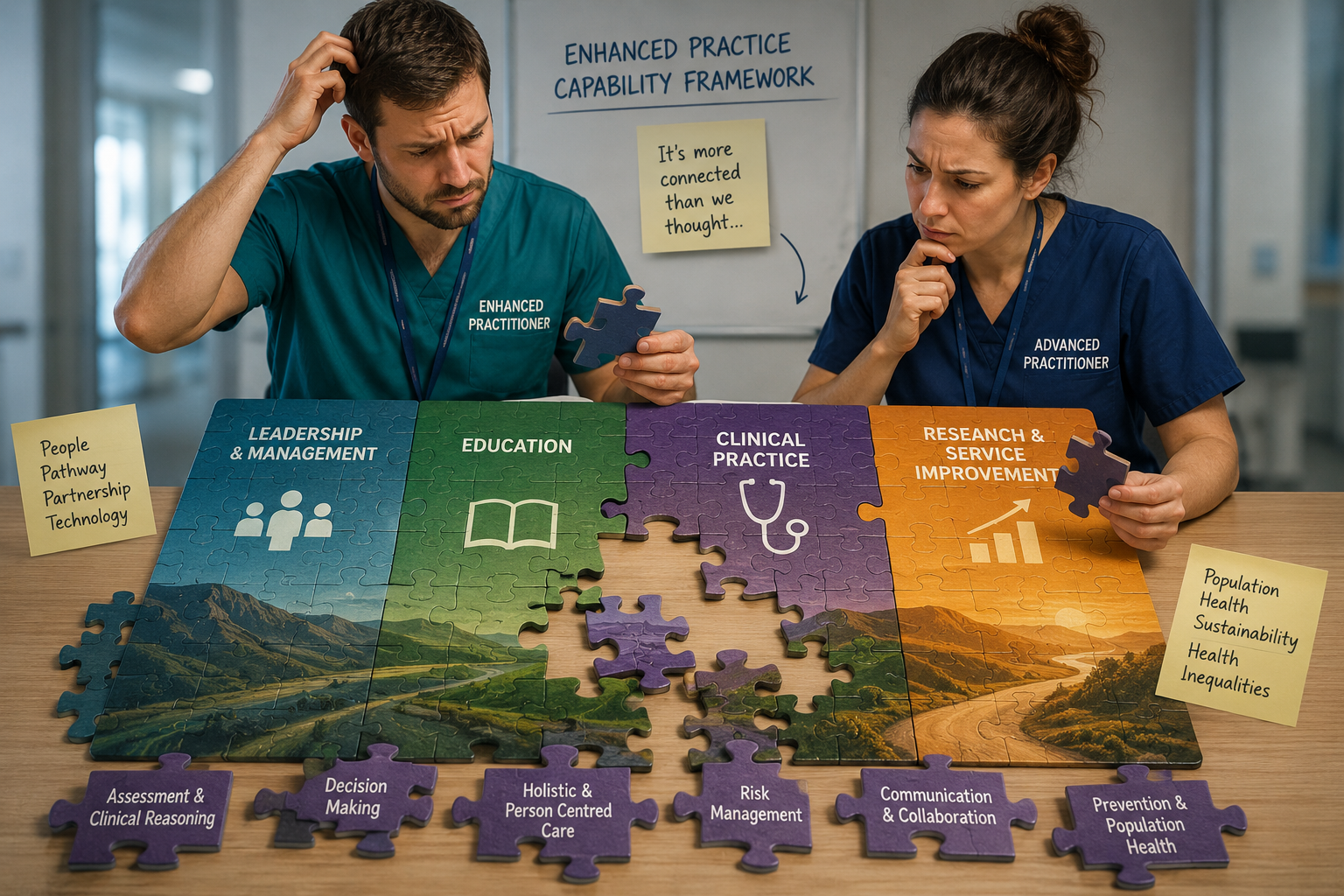
A few months ago, I wrote From Frameworks to Practice: Rethinking Capability for AHPs and Other Professionals in Urgent and Emergency Care, questioning whether urgent and emergency care really needed another capability framework. The challenge, I suggested, was not a lack of frameworks, but how we connect them, make them usable and support clinicians to apply capability in real-world practice.
Since then, I have been trying to do exactly that. But somewhere along the way, the work became less about bringing existing capabilities together and more about asking a much bigger question:
What does enhanced clinical practice actually look like?
The first pillar of the Urgent, Emergency and Crisis Care Enhanced Practice Capability Development Framework—Clinical Practice—is now at final draft stage. Getting there has taken longer than I originally anticipated, but the process has challenged some of my assumptions about enhanced practice, clinical skills and how capability develops.
The starting point was deliberately not to create something from scratch. There are already valuable capability frameworks covering individual professions, clinical specialties, frailty, urgent community response, virtual wards and enhanced nursing practice. The further I looked, the more frameworks I found, and there are certainly others that could be aligned in future.
But rather than create another isolated framework, I wanted to bring these existing capabilities together and make them more relevant to how urgent and emergency care is actually delivered across the pathway. Initially, this was relatively straightforward:
Map the capabilities
Identify common themes
Reduce duplication
Create a structure that could work across professions and clinical settings.
Once an initial draft was created, the capabilities were then shared through a series of validation surveys with clinicians working across urgent and emergency care, as well as people involved in leadership and education. Although the number of responses was lower than hoped, there was a good geographical spread across the UK, professions and parts of the UEC pathway. Feedback was also remarkably consistent, with strong overall support and most suggestions focused on clarification, reducing duplication or making small additions.
But as the Clinical Practice capabilities developed, it became apparent that this was only the beginning.
Was starting with clinical practice the best place to start?
Each survey covered a small number of capability topics and then the feedback from each survey was incorporated into the developing draft. As this process evolved, a familiar sequence began to emerge: assessment, clinical reasoning, decision-making, risk management, discharge planning, holistic care, communication, collaboration, prevention and public health.
Then one response stopped me in my tracks.
Up to that point, many of my questions had been about wording:
Was this the right word?
Was this capability in the right place?
Were we saying the same thing twice?
Suddenly, I was questioning the underlying level of practice.
Should enhanced practice assessment start with the presentation or with body systems?
In urgent and emergency care, clinicians frequently encounter presentations rather than confirmed diagnoses: a fall, dizziness, confusion, abdominal pain, shortness of breath or reduced mobility.
My thinking had been that enhanced practice should start with the presentation, while advanced practice would move towards a more systematic, multisystem approach. But this left me with another question: How do clinicians move from enhanced practice towards advanced practice, and how can these capabilities support that progression?
The answer I arrived at was that it isn't really about choosing between the two.
Enhanced practice can begin with a presentation-led approach, using clinical findings and reasoning to identify which body systems require further assessment. With experience, clinicians develop the ability to make those decisions more efficiently and confidently, increasingly considering the wider clinical picture.
Perhaps enhanced practice is therefore about developing the clinical reasoning to know which body systems need to be considered, when they need to be assessed and why.
That has changed how I think about the relationship between enhanced and advanced practice. Enhanced practice isn't simply “advanced practice-lite”. It develops the knowledge, reasoning, judgement and experience that enable clinicians to manage increasing complexity and uncertainty within their professional scope, providing a foundation for progression towards advanced practice.
The boundaries between capabilities became less clear—and that was useful
One of the most interesting things I have learnt is that the more closely you examine clinical practice, the harder it becomes to keep capabilities in neat categories.
Digital technology is a good example. It could easily be treated as a separate technical capability, yet digital tools increasingly influence clinical practice across assessment, clinical decision-making, multidisciplinary management and personalised care planning. Remote monitoring, virtual wards, digital communication and technology-enabled rehabilitation are becoming part of clinical practice rather than something separate from it.
The same happened with prevention and population health. As the Clinical Practice pillar developed, it became increasingly difficult to separate clinical care from health promotion, prevention, health inequalities, social prescribing, nutrition, physical activity, smoking and alcohol support, frailty and sustainable care.
These should not be additional tasks sitting outside clinical practice. They are increasingly being recognised as part of the clinical decision-making process itself, and so should be integrated within clinical capability.
That reinforced something I had suspected when I started. The pillars of practice provide structure for a framework, but practice doesn't happen in pillars. Clinical practice, leadership, education, research, digital technology and population health are interconnected. And so the challenge isn't to eliminate those boundaries, but to make the connections between them visible.
From a framework to a way of thinking about capability
Perhaps the biggest change in my thinking has been recognising that the framework isn't really about creating a definitive list of everything an enhanced practitioner should be able to do.
It is about creating a shared language for development.
A clinician should be able to use the framework to consider where they are confident, where they need further experience and which presentations or situations would challenge them. They can then begin to explore how their assessment informs their clinical reasoning, how that reasoning influences multidisciplinary management, what happens when the person moves beyond their immediate setting, and how they can evidence their development.
This is why the framework needs to act as more of a development resource. As the framework has developed, I have found myself adding more supporting materials, including:
Guidance around presentations and conditions
Definitions of key terminology
Examples and suggestions for demonstrating capability.
The intention isn't to create another checklist. It is to help clinicians develop breadth, recognise opportunities for learning and make their existing experience visible.
Integrating existing capability frameworks remains important. But the Clinical Practice pillar has taught me that integration happens at another level too. It is about bringing together:
Knowledge and clinical reasoning
Clinical reasoning and professional judgement
Assessment and decision-making
The individual encounter and the wider pathway
Clinical care and prevention
Technology and human decision-making
Professional expertise and multidisciplinary management
Ultimately, this is about developing clinicians who can integrate these different elements to respond effectively to complexity and uncertainty.
That is a much more ambitious proposition than simply producing another framework.
It is also why the process has taken longer than expected—and why I now think Clinical Practice was the right place to start. It has forced me to consider what enhanced practice actually means and has created some important questions to carry forward into the remaining pillars.
So where does this leave the framework?
The Clinical Practice pillar is now at final draft stage but there is still work to do on the remaining pillars.
The next chapter is Leadership and Management. Beginning that pillar has already raised some of the same questions: what does enhanced leadership actually look like in practice and how does it develop alongside clinical expertise?
And I suspect the answer will again be less about creating another list of competencies and more about understanding how leadership, communication, self-awareness, psychological safety, collaboration and system influence connect.
If this resonates with you, or you'd like to contribute your perspective or simply follow the journey, please do get in touch by completing the contact form below.
